Photonics: A Foundational Scaling Layer for AI-Era Computing
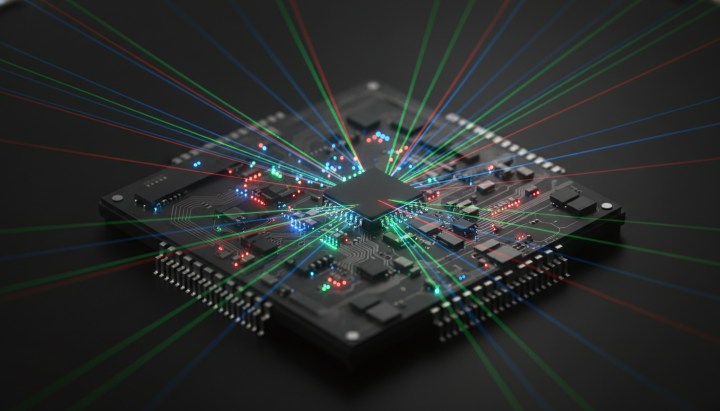
Photonics is becoming a foundational scaling layer for AI-era computing. Once discussed mainly in telecommunications and long-haul networking, optical technology is now appearing across the semiconductor ecosystem: inside data centers, at the edge of packages, between chips, across racks, and as part of computing itself. The reason is simple. The hardest problems in computing are no longer confined to the transistor. They are system-level problems: How to move more data over longer distances with lower latency, less power, and stronger security.
That shift is changing how the industry thinks about Moore’s Law. For decades, progress was measured by what could be packed onto a single chip. AI is stretching that definition. The new unit of performance is often not a processor, but a cluster. Large language models and generative AI systems routinely exceed the resources of a single server, requiring groups of accelerators to behave like one computer. In that environment, scaling is limited as much by communication and memory access as by raw compute.
Optical interconnect is emerging because AI computing has changed. Training, inference, retrieval, reasoning, and agentic applications place different stresses on memory, networking, and accelerators. As clusters grow, GPUs and AI accelerators must exchange parameters, activations, key-value caches, and intermediate results fast enough to keep utilization high. Every idle accelerator represents expensive silicon and power doing nothing. Copper remains useful over short interconnect lengths, but as bandwidth rises and distance grows, electrical signaling becomes harder to scale without penalties in loss, power, density, or complexity.
Memory is becoming the critical battleground. AI systems are often described as compute-hungry, but modern inference is increasingly memory-hungry. Long-context models and reasoning workloads generate and reuse large key-value caches. Agentic AI intensifies this pressure by requiring systems to preserve context across repeated reasoning steps, coordinate multiple tools and workflows, and support many concurrent users or autonomous agents. When memory is constrained, systems may shorten context, move data through slower tiers, reduce concurrency, or accept lower output quality. The business impact is direct: fewer high-value tokens per watt, per dollar, and per unit of installed infrastructure.
This is why memory cannot remain strictly local. High-bandwidth memory attached to an accelerator is valuable, but finite and expensive. As workloads scale, systems need access to larger shared memory pools without forcing every byte through a slow storage-like path. Protocols such as Compute Express Link (CXL) enable low-latency, coherent access to pooled and disaggregated memory. Paired with optical networking, this model can extend memory across boards, servers, and racks while preserving the semantics needed by CPUs, GPUs, AI accelerators, and FPGAs. Optics can turn memory from a stranded local resource into a composable system resource.
The same logic applies to compute scaling. AI workloads rely on shared memory footprints and fast communication across a distributed system, not just compute inside one box. A rack of accelerators is useful only if they can be programmed and fed as a coordinated machine. Optical links and optical switching excel at providing the bandwidth, latency, reach, and topology flexibility needed to connect devices at multiple levels: chip-to-chip, package-to-package, rack-to-rack, and cluster-to-cluster. Over time, this points toward data centers whose topology can be shaped around workloads rather than fixed by copper traces and static cabling.
Optical computing adds another layer. Not every workload is suitable for optics, but many high-value operations in AI and scientific computing are dominated by linear algebra and parallel data movement. Photonic processors can perform certain matrix and vector operations with very low latency and attractive energy characteristics. The most successful designs are likely to be workload-first rather than physics-first: pairing optical processing with electronics, software stacks, compilers, and application frameworks so the right parts of the workload run in the right medium.
Photonics also has underappreciated advantages outside speed and power. Optical media are immune to electromagnetic interference because signals are carried by light rather than electrical current. They also do not radiate electromagnetic signals in the same way metal interconnects do. That matters in electrically noisy environments, defense applications, medical infrastructure, and anywhere signal leakage or interference creates risk. While no technology is automatically secure, optical links reduce certain electromagnetic side channels and can make passive interception more difficult than with conductive media.
The next phase of photonics will be defined by breadth. Pluggable optics, co-packaged optics, optical I/O chiplets, optical circuit switches, CXL-enabled memory fabrics, and optical accelerators all address different parts of the same system-level problem. AI has exposed the limits of moving data with electrons alone, but the implications extend far beyond AI. As data grows faster than conventional infrastructure can comfortably move it, photonics will continue expanding its role as a foundational scaling layer for AI-era computing, especially as data centers, advanced memory systems, and next-generation workloads place unprecedented demands on bandwidth, latency, power, reach, and security.