Google’s Antigravity Signals a Shift Beyond the IDE
The most important takeaway everyone missed at the 2026 Google I/O Conference.
For the past few decades, software development has revolved around humans writing software. The integrated development environment (IDE) sat at the center of the process as the specialized tool where developers edited, compiled, debugged, and managed code and projects. AI coding assistance has recently been added to these IDEs, but humans remain at the center of writing software.
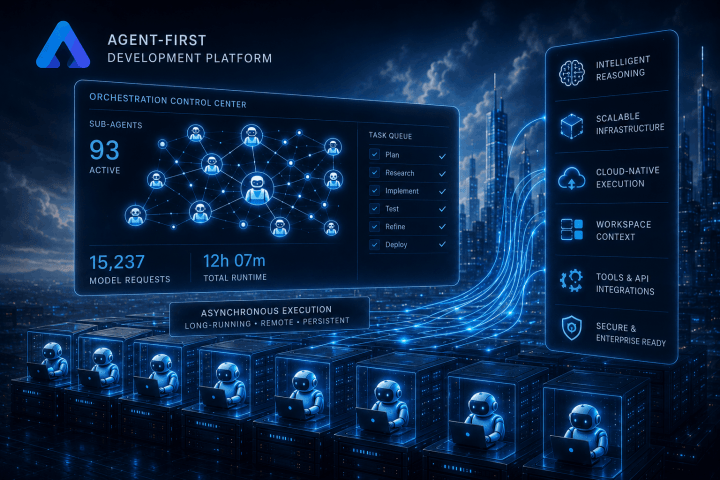
At Google I/O 2026, Google signaled something much larger than another generation of AI coding assistance. The company introduced Antigravity 2.0 as an “agent-first” development platform. Instead of being built around coding, it is built around orchestration, sub-agents, asynchronous execution, and long-running tasks.That language matters because those are not IDE concepts. They are concepts typically associated with distributed systems.
One of the most important takeaways from Google I/O was not that AI can now write more code. The industry already expected that. The more significant shift is that Google appears to believe software development is evolving from human-driven programming into agent-driven orchestration. That is a fundamentally different path forward.
The demos themselves revealed the direction clearly. Google described Antigravity 2.0 as supporting sub-agents, hooks, remote execution environments, scheduled tasks, and persistent background operations. Developers were shown managing fleets of AI workers operating asynchronously across multiple projects rather than simply interacting with a smarter autocomplete engine.
The operating system demo illustrated this perfectly. Much of the audience focused on the spectacle of AI building a functioning operating system. But that was not the important part of the presentation. The real story was coordination.
Google described a workflow involving 93 sub-agents processing more than 15,000 model requests over 12 hours to complete the task. The breakthrough was not code generation in isolation. The breakthrough was autonomous task decomposition, workload distribution, iterative testing, and asynchronous execution operating together as a cohesive system.
That starts to look less like an IDE and more like an operating environment for AI workers. The distinction matters because the AI market is already beginning to shift. Frontier models remain important, but the market increasingly understands that raw intelligence alone is unlikely to produce a durable competitive advantage. Performance gaps between top-tier models continue to narrow. Open models continue to improve. Inference pricing continues to decline. Over time, many enterprise workloads will view frontier models as interchangeable infrastructure rather than differentiated products.
As models become a commodity, value moves upward in the stack. That shift favors orchestration layers, workflow systems, execution environments, integrations, memory persistence, observability, and security controls. Those are the areas where long-term stickiness will likely emerge. Historically, infrastructure layers that coordinate complexity tend to become more defensible than the underlying compute engines themselves. Google’s positioning around Antigravity strongly suggests the company understands this transition.
Throughout the presentations, Google repeatedly emphasized speed, throughput, orchestration, and operational workflow rather than focusing exclusively on benchmark leadership. The company showcased managed agents paired with sandboxed Linux environments, autonomous workflows operating through APIs, cloud-backed execution systems, and integrations spanning Google’s Workspace, Android, Firebase, and Cloud Run tooling.
Viewed together, the strategy becomes clear. Google is not simply building better AI models; it is building a vertically integrated execution stack for autonomous digital labor. Gemini provides the reasoning layer. TPUs provide the infrastructure. Antigravity provides orchestration. Cloud provides persistent execution. Workspace provides enterprise context. Android and web applications provide user-facing surfaces. The result begins to resemble, as mentioned earlier, an operating system for AI workers.
This also explains why many of the most important demonstrations at Google I/O extended far beyond software development. Google showcased research agents, marketing agents, dashboard generation, Android app creation, business analysis tools, and autonomous workflows connected directly into enterprise productivity systems.
Software engineering is simply the first domain where agent orchestration becomes economically obvious. Once orchestration systems mature, the same architecture can expand into finance, operations, customer support, analytics, procurement, and eventually most forms of knowledge work. Enterprises will increasingly require systems capable of managing thousands of semi-autonomous agents operating continuously across business processes.
That creates an entirely new infrastructure category that shifts the future competitive battlefield away from which company has the smartest model. The battlefield will instead revolve around who controls the workflow layer that manages autonomous digital workers at scale and best binds them to its ecosystem and products.
That possibility changes how the industry should interpret Antigravity 2.0. For years, the IDE represented the center of software development. Developers lived inside editors because software creation revolved around humans manually producing code. AI initially appeared as an enhancement to that workflow through autocomplete, code suggestions, and chat assistants. Google now appears to be betting on a different model entirely.
In this emerging framework, developers increasingly supervise systems rather than directly author implementations. The human role shifts toward defining objectives, validating outputs, coordinating workflows, and managing agent behavior. Code itself becomes less important than orchestration.
That is why the most important statement from Google I/O was never explicitly spoken on stage. Google thinks the IDE is dead, but not because software development disappears, and not because humans stop building systems. It just believes the center of gravity is shifting away from the editor and toward the runtime managing autonomous agents behind it. The IDE does not vanish; it simply becomes another surface layered on top of an agent operating system.
Read also:
At the Gartner Supply Chain Symposium/Xpo, Alan O’Keeffe, VP analyst at Gartner, opened the event by addressing industry leaders grappling with volatile oil prices, geopolitical tensions, conflicts in the Middle East, and ongoing logistics disruptions.
Cadence has launched the ChipStack AI Super Agent, an agentic AI solution for front-end silicon design and verification. The platform automates key design and test workflows—including coding, test plan creation, regression testing, debugging, and issue resolution.
Suggested content from our partner Arrow:
More from EE Times:
RELATED TOPICS:AI AGENTS, AI CODING, AI MODELS, INTEGRATED DEVELOPMENT ENVIRONMENTS (IDES), SOFTWARE AUTOMATION
COMPANIES:GOOGLE, TIRIAS RESEARCH
_Kevin Hein is a senior analyst at Tirias Research. He is a senior technology executive with over 30 years of experience designing, delivering, and modernizing complex software and systems across commercial, government, and mission-critical environments._
0 comments