
Chiplets, Ecosystems, and Europe’s Post-Fab Semiconductor Strategy
For years, Europe’s semiconductor ambitions were measured in fabs, process nodes, and manufacturing sovereignty. The European Chips Act elevated semiconductors to the level of strategic industrial policy, triggering a wave of subsidies and investment proposals aimed at rebuilding manufacturing capacity across the continent.
Yet despite those efforts, Europe’s position in the global semiconductor industry continues to weaken. Few executives have watched Europe’s semiconductor industry evolve as closely as Maria Marced, who now helps shape discussions around Chips Act 2.0. According to Marced, Europe’s global semiconductor market share could fall to around 6% this year.
Maria Marced
“That’s quite pathetic, frankly speaking,” Marced told EE Times. “The focus now on the Chips Act 2.0 is the other way around. The focus is more on [the] end-to-end ecosystem, from chips up to the final product.”
That shift reflects a broader transformation underway across the semiconductor industry itself. As AI, autonomous systems, robotics, and advanced edge computing drive exponentially greater compute demands, semiconductor architectures are becoming increasingly modular and heterogeneous. Instead of relying exclusively on ever-larger monolithic chips, companies are increasingly assembling systems from multiple interconnected components—chiplets—linked through advanced packaging and high-speed interfaces.
For Europe, that transition may create an opportunity to compete differently. Rather than attempting to replicate the manufacturing scale of Taiwan, South Korea, or the U.S., Europe is increasingly positioning itself around what some industry leaders see as the semiconductor industry’s next strategic layer: ecosystem coordination, interoperability, advanced packaging, and system-level integration.
Automotive pushed imec toward chiplets
Imec’s Peter Vandersteegen
At imec, Peter Vandersteegen, portfolio manager for automotive, is helping lead the organization’s transition from its Automotive Chiplet Program toward a broader Autonomous Edge Chiplet Program spanning robotics, security, and AI-driven systems.
The shift began with automotive.
“The high-performance compute is basically determining your relation with the car,” Vandersteegen told EE Times. “But to make that happen, you actually need a large amount of compute power in that car.”
The challenge, however, is economic as much as technical. Autonomous driving systems increasingly require leading-edge semiconductor technology, but automotive volumes remain relatively limited compared with hyperscale AI or smartphone markets. Developing fully custom monolithic processors at advanced nodes is becoming prohibitively expensive for many automotive applications.
“To develop a high-performance compute engine, you actually need scale to justify that investment,” Vandersteegen said. “However, those technology nodes, especially the development, are quite costly. And the amount of cars is not increasing.”
That pressure is helping drive interest in chiplets—modular semiconductor building blocks that can be integrated into larger systems through advanced packaging technologies. Rather than designing an entirely new chip for every application, companies can reuse and combine smaller functional blocks across multiple systems and industries.
“Chiplets simply are a way to support high-performance compute because they basically enable scalability and modularity,” Vandersteegen said.
What began as a solution to automotive compute economics quickly evolved into something larger. Imec realized that many of the same requirements shaping autonomous vehicles also apply to robotics, industrial automation, and other AI-driven autonomous systems. Those systems must interact safely with unpredictable environments, while balancing increasingly complex compute demands against limited deployment volumes—limited at least in the initial phases.
As a result, imec’s focus gradually expanded from automotive-specific chiplets toward broader ecosystem infrastructure.
The rise of interoperability ecosystems
That transition also exposed one of the central realities of heterogeneous integration: Chiplets only work at scale if components from multiple vendors can interoperate reliably. Vandersteegen said global standards will help overcome that challenge.
The shift toward chiplets changes more than chip architecture. It changes the structure of the semiconductor industry itself. Instead of vertically integrated systems built largely within a single company, heterogeneous integration increasingly depends on coordination across foundries, chip designers, packaging specialists, software developers, automotive suppliers, and standards committees.
That reality is pushing organizations such as imec into areas that historically sat outside traditional semiconductor R&D. Vandersteegen said the institute’s Automotive Chiplet Program increasingly focused on issues such as reliability validation, thermal stress analysis, compliance testing, and multi-vendor interoperability. The goal is not simply to develop chiplets, but to create the infrastructure necessary for chiplet ecosystems to function reliably in demanding environments such as autonomous vehicles.
To support that effort, imec established a new site in Heilbronn, Germany, focused on prototyping and compliance testing for chiplet-based systems. It is also participating in efforts to standardize chiplet interfaces, an increasingly strategic issue as heterogeneous computing systems become more modular and multi-vendor by design.
In many ways, the rise of chiplets resembles earlier platform transitions in computing and telecommunications, where standards and ecosystem control often became as important as the underlying hardware itself.
Europe’s post-fab opportunity
Marced argues that this transition may align unusually well with Europe’s industrial structure, particularly in automotive and industrial systems. “Chiplets could be a good approach to solve all the questions around the technology in automotive,” she said.
Unlike hyperscale cloud computing or consumer smartphones, automotive systems prioritize long lifecycles, safety, reliability, and integration across complex industrial supply chains— areas where Europe has historically maintained strong expertise.
For Marced, Europe’s future competitiveness may depend less on matching Asia’s manufacturing scale and more on building end-to-end ecosystems around design, integration, and heterogeneous computing. “Instead of building fabs, it’s about focusing on design,” she said.
That doesn’t mean fabs become irrelevant. Europe continues to pursue manufacturing investments through projects involving Intel, TSMC, STMicroelectronics, and GlobalFoundries. But industry leaders increasingly acknowledge that manufacturing scale alone is unlikely to restore Europe’s semiconductor leadership.
“Can Europe realistically compete on leading-edge fabs alone?” Marced said. “No.”
Instead, Europe’s opportunity may lie in becoming indispensable in the infrastructure layer surrounding heterogeneous computing systems: advanced packaging, chiplet interoperability, automotive integration, prototyping, and ecosystem coordination.
That shift is also beginning to influence discussions around Chips Act 2.0, which Marced said is increasingly moving beyond a pure manufacturing focus toward broader support for ecosystem development, startups, and design capabilities.
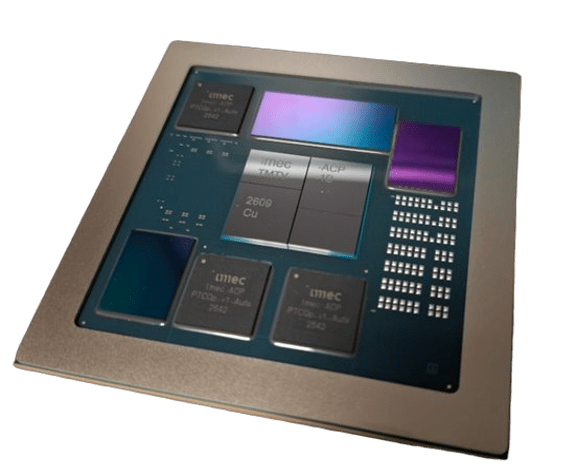
Imec’s thermal mechanical test vehicle determines the reliability of chiplet-based systems in packages. (Source: imec)
The next semiconductor battleground
The broader implication is that semiconductor leadership itself may be changing definition. For decades, the industry’s center of gravity revolved around transistor density and manufacturing scale. But as heterogeneous systems become more complex, value may increasingly shift toward the ability to coordinate ecosystems spanning multiple technologies, companies, and industries.
In that environment, interoperability standards, shared platforms, and integration infrastructure become strategic assets.
“Whenever you lead a movement, whether it’s standards or ecosystems, being a central figure helps you win the market,” Marced said.
Ironically, the collaborative and cross-border structure that has often been viewed as a weakness for Europe’s semiconductor industry may become more relevant in a chiplet-driven era where no single company can build every part of the system alone.
The next semiconductor race may still involve fabs. But increasingly, it may also revolve around who defines the interfaces, standards, and ecosystems that connect them.