Nikon Leveraging ArF Scanner Price to Challenge ASML
Nikon is making waves by announcing plans to lower the price of its lithography equipment by manufacturing several parts in-house to reduce overall costs. CEO Yasuhiro Ohmura, who took charge in April this year, told Nikkei Asia that Nikon is talking to several large chipmakers in the United States and Asia about supplying argon fluoride (ArF) tools, and some discussions are nearing purchase orders.
The company also plans to launch a new ArF immersion platform—featuring a new lens and wafer stage—by 2028 while also building compatibility with ASML’s lithography tools. That’s crucial because, while price matters, problems arise when fab engineers try to align a layer on a Nikon tool back to a layer patterned with an ASML tool.
It’s also important to note that while ASML enjoys a monopoly position in extreme ultraviolet (EUV) lithography systems, ArF immersion is a part of mature deep ultraviolet (DUV) technology. However, even 3-nm process nodes run many patterning steps on ArF immersion. In other words, this mature part of the DUV process remains important even for advanced chips.
ASML directly competes with Japan’s Canon and Nikon in older DUV lithography equipment. However, ASML and Nikon are the only two firms that build ArF lithography equipment. Although their scanner technology roadmaps are completely different.
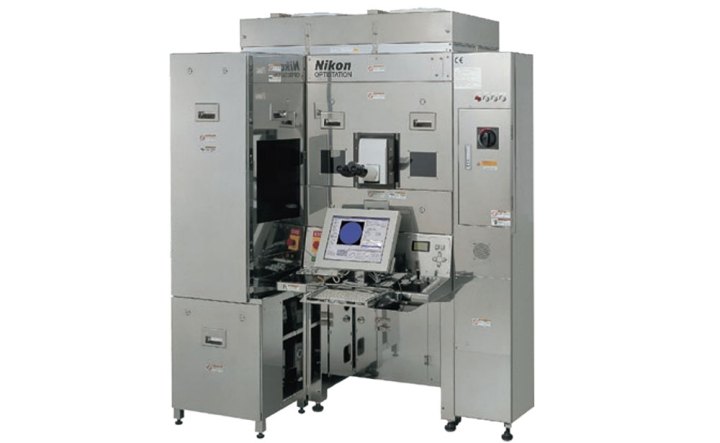
The NSR-S625E ArF immersion scanner features a resolution of 38 nm, a numerical aperture of 1.35, and a 193-nm excimer laser. (Source: Nikon)
The upside
There’s broad consensus among industry watchers that ASML won’t lose sleep over Nikon’s DUV equipment sales. The real challenge will be if Nikon manages to build EUV machines, which are highly complex marvels of system engineering.
Some industry observers call Nikon the next Intel, whose foundry bet was eventually rescued by a lack of fab capacity, while TSMC still dominates the chip contact manufacturing business. They reckon that Nikon’s move to lower prices of lithography solutions could help the fab equipment shortage caused by the supply backlog from ASML.
Then there’s another dimension favoring Nikon: a single company having a monopoly on lithographic machines for semiconductor fabs is a red flag for the hypercompetitive chip industry. So, competition matters in the lithography market even if Nikon is years behind. And even when all three mega-fabs—Intel, Samsung, and TSMC—are shareholders of ASML.
The downside
For a start, as several market analysts note, price is largely irrelevant for the commercial specs of lithography machines. They point out that Nikon’s immersion scanners are already priced a double-digit percentage below ASML’s equivalent offering, and that Nikon’s market share is still declining.
That’s one reason why Nikon intends to develop a completely new immersion scanner platform that’s technically competitive with an ASML scanner. Nikon’s upcoming scanner will incorporate a new projection lens to match ASML’s mask mirroring. The current masks in Nikon’s scanner can’t be shared with ASML.
The upcoming scanner will also introduce a new wafer stage to enable correction of wafer stage hardware, allowing fabs to stop using multiple sets of scanners. However, as mentioned above, this new scanner is planned for launch by 2028, and a lot could change in the highly competitive lithography landscape during this period.
Next comes the entrenchment factor. Fabs like TSMC have a long track record of working with ASML, and these fabs have acquired a deep technical expertise in integrating ASML components and systems into their manufacturing ecosystems. What if a lower-cost machine costs twice as much to integrate, or if it doesn’t achieve the required yield?
Finally, as many in the industry point out, Nikon’s rise and fall mirrors what happened to the Japanese semiconductor industry at large over the past two decades or so. In retrospect, Japanese chipmakers and semiconductor equipment makers such as Canon and Nikon declined together. Can Nikon defy this downward trend?
A quest for turnaround
At a time when lithography is rapidly evolving, Nikon is making a bet on revival through close collaboration with key suppliers and research labs. But can it put a reverse to ASML’s “winner takes it all” story in the lithography world? Especially after losing the DUV race to ASML, now an undisputed leader with more than 8,000 semiconductor lithography systems installed worldwide?
Nevertheless, Nikon needs a turnaround, and ASML’s advanced ArF immersion system, priced at around $82.5 million, smells like an opportunity. Add to this the fact that a few DUV machines usually accompany every EUV machine. Nikon’s strategic pivot to aggressively compete on price could also enable fabs to negotiate more effectively with ASML.
Nikon is positioning itself as a second-source option for semiconductor fabs that don’t want to rely only on ASML. It will be interesting to see if Nikon can attract fabs with lower equipment costs and a second-source option.