
ScioSense Launches UFC23 Ultrasonic Flow Converter for High-Precision, Ultra-Low-Power Smart Metering
Dutch sensor manufacturer ScioSense has launched its fourth-generation ultrasonic flow converter (UFC), called UFC23, for water, heat, and gas metering applications. The company said the new sensor combines high measurement precision, improved offset stability, and ultra-low power consumption for battery-powered smart metering systems.
The company’s latest product is designed as pure front-end architecture without an on-chip CPU, allowing OEMs to perform flow calculations on their preferred host microcontrollers from companies such as STMicroelectronics, NXP, and Renesas. The company said this approach gives meter manufacturers greater flexibility in system design while improving analog front-end performance.
EE Times interviewed Norbert Breyer, director of marketing and product management at ScioSense, who said: “We want to relieve customers from developing the analog front end for an ultrasonic meter. With our separate approach, where the front end manages the flow measurement and the customer has full flexibility on the microcontroller side, users can move to the latest generations of microcontrollers whenever they want. We are also cooperating with the suppliers to develop sample code for their microcontroller platforms.”
Breyer explained that earlier products such as the GP30 and AS6031 included small proprietary CPUs capable of handling flow calculations internally. These products also offered firmware-integrated versions for customers with limited software expertise. However, newer smart meter designs increasingly require higher processing capability and bidirectional flow measurement, pushing customers toward performing flow calculations using external microcontrollers.
“Customers told us that they liked the GP30 and AS6031 because of their strong performance, but they wanted similar performance without the CPU,” Breyer said. “That is why we introduced UFC23.”
The UFC23 integrates ultrasonic transducer drive functions, signal capture, and high-precision time-of-flight extraction. It also includes a programmable gain amplifier with increased gain and bandwidth, a programmable ultrasonic burst generator operating up to 4.40MHz, and batch measurement capability that allows the sensor to collect up to 12 measurement bundles before waking the host controller.
The UFC23 operates with a standby current of typically 0.8 microamps and an operating current as low as 6.60 microamps at an 8Hz sample rate. The converter supports both 3.3 V single-ended drive for water applications and full-bridge drive for gas applications.
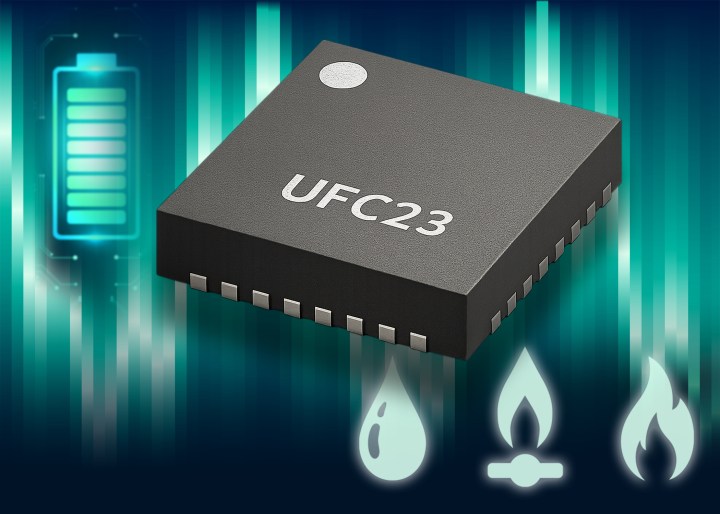
The ScioSense UFC23 time-to-digital converter IC, designed for ultra-low-power flow measurement in utility meters and industrial applications. (Source: ScioSense)
ScioSense is focusing heavily on low-power operation because smart meters operate using batteries that are expected to last between 10 and 20 years.
Breyer said the company’s solutions typically operate at current consumption levels between 5 and 8 microamps. At 88Hz operation, current consumption is around 6.50 microamps and can be reduced to approximately 4 microamps using adaptive sampling algorithms.
“The target lifetime for these products is 20 years,” Breyer said. “With a AAA cell, if the microcontroller is power-efficient, operation for 20 years should be achievable.”
Breyer explained that the company’s UFC front-end chips connect directly to ultrasonic spool pieces and transducers. Data can then be read through serial peripheral interface (SPI) using the customer’s central microcontroller.
Ultrasonic meters replace mechanical turbine meters
Breyer pointed out the trend of ultrasonic meters replacing traditional mechanical turbine meters because they provide higher sensitivity, longer lifetime, and lower maintenance requirements.
“Dirt and contaminants in water can eventually stop the turbine from rotating, resulting in measurement errors and shorter operating life. With ultrasonic technology, customers want to replace this mechanical sensor with a static sensor. There are no moving parts. Dirt in the water cannot cause the mechanical turbine to get stuck because nothing rotates,” he explained.
Breyer said ultrasonic meters can detect flows as low as 0.50 liters per hour, compared to approximately 5 liters per hour for mechanical turbine meters. This allows utilities to identify dripping taps, leaking pipelines, and faulty toilet valves much earlier.
He added that mechanical turbine meters can show errors of around 30% after six years because aging affects turbine movement.
“Utilities therefore benefit financially from replacing mechanical meters with ultrasonic meters because they can conserve water and bill more accurately,” Breyer said.
The UFC23 supports applications including smart water meters, heat meters, gas meters, water heaters, pump control systems, smart faucets, and leak detection systems. ScioSense said samples and evaluation kits are already available through distribution partners.
Challenges in ultrasonic metering
According to Breyer, one of the biggest technical challenges in ultrasonic metering is measuring time-of-flight differences with picosecond-level precision. In ultrasonic meters, two transducers send ultrasonic waves in opposite directions through the fluid. The system calculates flow by measuring changes in travel time.
For small meters, the time of flight is typically around 30 microseconds, while larger meters may operate between 70 and 100 microseconds.
“The latest market trend is toward a 1:1000 measurement ratio, which requires precision around 10 picoseconds,” Breyer said.
He added that ScioSense front ends currently achieve approximately 35 picoseconds in single-shot measurements, while averaging further improves performance. The offset stability is ±7 picoseconds using 128-sample averaging, with drift below 10 picoseconds across a temperature range from 0°C to 50°C in a typical DN15 water meter configuration.
“We are focusing on maintaining measurement stability across temperature variations because temperature stability directly affects metering accuracy,” Breyer said.
Business operations
Water metering currently accounts for around 70% of ScioSense’s flow business, while heat contributes around 20% and gas approximately 10%. He expects the ratio to move closer to 2:1:1 between water, heat, and gas in the medium term.
“While the heat meter market remains relatively stable, gas metering demand in Europe has slowed because of reduced dependence on gas-based heating following the war in the region. However, China continues showing strong interest in gas metering,” he said.
Breyer said Europe currently represents the strongest ultrasonic metering market, with an estimated 50% of the sector already transitioning toward ultrasonic technology. He added that China has rapidly increased ultrasonic meter adoption during the past five years, while India is now showing strong interest.
“America is also a strong market, and many leading manufacturers are shifting toward ultrasonic technology. We have many Indian customers beginning development of ultrasonic water meters,” Breyer said.
ScioSense operates as a fabless semiconductor vendor. The company uses a German foundry with production carried out in Asia.
“We cooperate with globally active companies that can easily handle high production volumes, so manufacturing capacity is not a limitation,” he said.
The company works directly with OEMs globally rather than electronics manufacturing services providers.
The sensor manufacturer provides evaluation boards, demonstrator software, and sample code for Arduino and STMicroelectronics microcontrollers through GitHub. Breyer said the company works with distributors including DigiKey, Mouser, Avnet India, Future Electronics, and WT Microelectronics. Customers can purchase individual quantities or evaluation kits through these partners.
“For higher quantities, we typically sell in reels containing 1,000 pieces,” he said.
Technical support is generally provided directly by ScioSense because distributors may not possess the same level of system expertise.
ScioSense is researching water quality sensing technologies as a possible future expansion beyond conventional flow metering. Breyer said the industry is still determining how water quality should be defined and measured.
“It could involve parameters such as pH, chlorine, carbon dioxide, or other factors. At the moment it is still at the research stage,” he said.