
Manufacturing Accelerates in May Amid Inflation and Geopolitical Headwinds
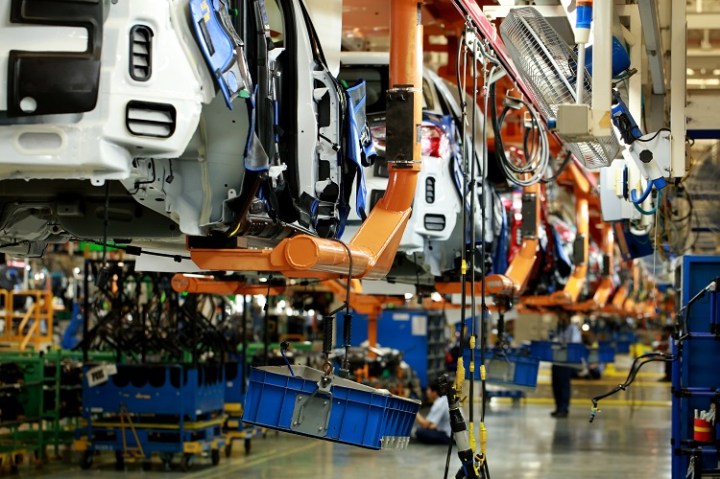
Manufacturing expanded further last month despite Inflation and lower GDP.
U.S. manufacturing activity expanded at its fastest pace in two years this May, contrasting with a broader deceleration across the national economy.
The Institute for Supply Management reported that its Manufacturing Purchasing Managers’ Index registered 54% in May, up 1.3 percentage points from April. This robust industrial performance diverges from the broader U.S. macroeconomic picture.
The U.S. Commerce Department recently revised first-quarter gross domestic product growth down to a 1.6% seasonally and inflation-adjusted annual rate. That downgrade was largely tied to lower estimates for inventory investment and a downward revision in consumer spending on services.
Source: Bureau of Economic Analysis
Despite this macroeconomic cooling, the industrial sector notched its fifth consecutive month of expansion, reaching its highest level since May 2022.
Demand and output strengthen
Key manufacturing indicators sent strong positive signals as the second quarter progressed. The New Orders Index expanded for the fifth consecutive month, registering 56.8%, which is up a robust 2.7 percentage points from April.
(Source:Institute for Supply Management)
Demand sentiment was notably positive, featuring a 1.6-to-1 ratio of positive to negative comments among survey respondents. Output also accelerated, with the Production Index rising to 54.3%, marking a seventh consecutive month of expansion.
Susan Spence, chair of the ISM Manufacturing Business Survey Committee, noted the sector’s momentum, stating, “The overall economy continued in expansion for the 19th month in a row.” Spence added that historically, a May reading of 54% corresponds to a 2.2% annualized increase in real gross domestic product.
Employment remains slow
While production and orders grew, the labor picture remained challenged, albeit improving slightly. The Employment Index registered 48.6% in May, an increase of 2.2 percentage points from April, but still marking its 32nd consecutive month of contraction.
Susan Spence (Source:ISM)
Manufacturers continue to manage headcounts carefully rather than actively expanding their workforces to meet new orders. Spence indicated that half of the survey panelists reported managing headcounts remains the norm at their companies, while the other half are hiring, resulting in an even 1-to-1 ratio of hiring to managing or reducing staff.
Supply chain friction and Middle East conflict
Inflationary pressures continue to tighten their grip on the industrial sector. The ISM Prices Index registered 82.1% in May. While this represents a 2.5-percentage point decrease from April’s alarming surge, it indicates that raw material prices have increased for the 20th straight month.
Spence attributed this persistent pricing pressure to a combination of factors, including increases in steel and aluminum prices that affect the entire value chain, tariffs on imported goods, and increases in petroleum-based products resulting from the ongoing Middle East conflict.
The ongoing war involving Iran and broader tensions in the Middle East are actively disrupting supply chains and driving up energy costs. One executive in the Transportation Equipment sector warned that the Iran conflict is starting to “directly and negatively impact the cost of supply chain,” as oil and related commodities escalate in price.
Another respondent in the Machinery space noted that the Middle East conflict is “triggering shipment delays and uncertainties.” Consequently, supply deliveries remain sluggish, with the Supplier Deliveries Index registering 60.6%, matching its April figure and remaining at its highest level since May 2022.
Uncertain outlook
The geopolitical landscape continues to cast a long shadow over corporate planning. In May, 69% of panelists’ comments were negative, yielding a positive-to-negative sentiment ratio of 1-to-2.7.
Mentions of the Iran war surfaced in 42% of all comments, while tariffs were cited in 18%. Furthermore, 57% of the panelists mentioned pricing volatility as a significant issue for their companies.
One executive in Miscellaneous Manufacturing described the current atmosphere as one of “extreme uncertainty and concern for the future in terms of both price stability and longer-term supply continuity related to the Iran conflict and Strait of Hormuz closure”.
Despite these escalating obstacles, the manufacturing sector as a whole showed broad resilience, with all six of the largest manufacturing industries and 16 of the 18 tracked industries reporting growth in May.
This corporate resilience mirrors a silver lining in the broader U.S. economy; according to recent Commerce Department data, a key measure of U.S. business earnings—profits after tax without inventory valuation and capital consumption adjustments—jumped 17% from a year ago, marking the largest year-over-year change in corporate profits since the final quarter of 2021.
See also:
RELATED TOPICS:EMPLOYMENT, GDP, INVENTORY, ISM, MIDDLE EAST WAR, PRICING, SUPPLY CHAIN AND DISTRIBUTION
COMPANIES:INSTITUTE FOR SUPPLY MANAGEMENT
_The Supply Chain News Desk compiles information relevant to the electronics supply chain, including industry reports and statistics; logistics data, standards, governance and company announcements; personnel notifications and other items of note._
0 comments